
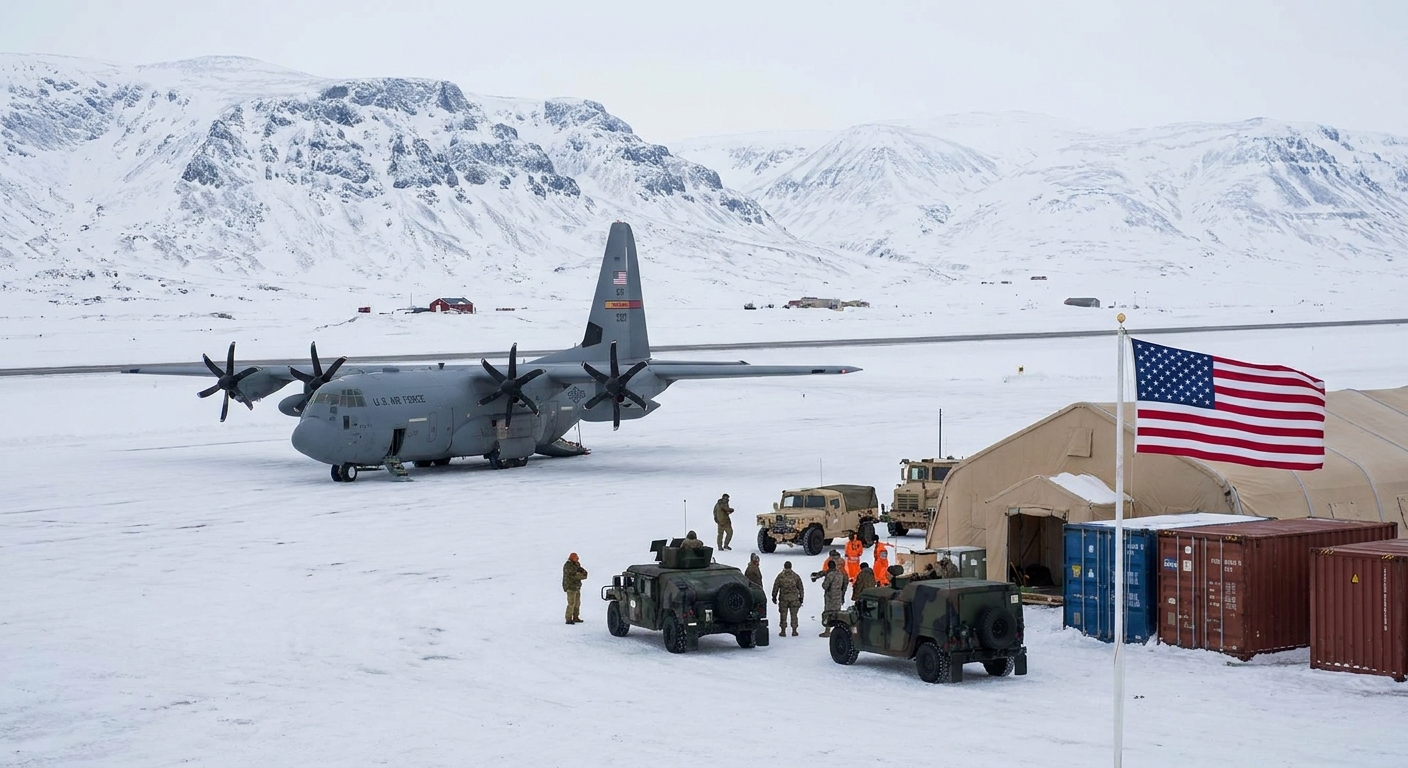
Under a landmark trilateral agreement scheduled to be signed this week, the United States is poised to broaden its military footprint in Greenland by activating two strategic installations. According to individuals familiar with the diplomatic proceedings, representatives from Washington, Copenhagen, and Nuuk will formally conclude the accord during sessions at the United Nations General Assembly in New York. The diplomatic breakthrough signals a renewed American interest in far-northern defense infrastructure, restoring access to areas that have seen little foreign military activity since the mid-twentieth century.
Strategic Locations Across Southern and Eastern Coasts
The planned expansion centers on two distinct geographic outposts situated on opposite shores of the island. In southern Greenland, American personnel will re-establish a presence at Narsarsuaq, an isolated settlement that previously functioned as an American installation known as Bluie West One before being decommissioned in the nineteen-fifties. The community’s population has shrunk to only a few dozen people in recent decades.
Along the eastern coastline, the initiative focuses on Mestersvig, a remote station that currently serves as an operational base for the elite Danish Sirius Dog Sled Patrol. Utilizing both locations will allow the United States to significantly bolster its regional reconnaissance, staging, and logistics across strategic polar sea routes.
High-Level Diplomacy at the United Nations
Diplomats are scheduled to convene on September 21, 2026, at the United Nations to formally sign the agreement. Because the exact stipulations remain confidential until the signing ceremony, sources said they were resolving technical elements in the final hours before the event.
Representatives from both Denmark and Greenland did not issue immediate remarks. Meanwhile, a White House spokesperson refrained from discussing specific operational provisions, saying only that the completed pact would enhance and safeguard the national defense priorities shared by Greenland and the United States.
Integrating Arctic Security into the Western Alliance
From the perspective of Danish leadership, the expanded security arrangement anchors regional protection within the broader framework of the North Atlantic Treaty Organization. By placing these installations under the defensive banner of the Western alliance, Copenhagen seeks to ensure Arctic operations are governed through multilateral cooperation rather than an isolated bilateral partnership with Washington. Officials believe this collective alliance structure will balance regional stability while mitigating external diplomatic friction.
Geopolitical Friction and Historical Troop Reductions
The agreement follows a protracted period of diplomatic tension fueled by the current administration in the United States, which repeatedly signaled its intent to secure dominance over the self-governing Danish territory.
The administration repeatedly left open the possibility of using financial or military measures to gain control, prompting widespread indignation among local Greenlandic residents, who overwhelmingly rejected any surrender of sovereignty. The resulting diplomatic strain peaked early in the year, rattling cohesion among transatlantic allies and ultimately pushing Danish and Greenlandic negotiators to the conference table to defuse Washington’s demands.
The forthcoming reactivation stands in stark contrast to earlier eras of military presence. During the height of the Cold War, the American armed forces operated seventeen bases across Greenland staffed by more than ten thousand personnel. Decades of post-Cold War drawdowns drastically curtailed that footprint, leaving only Pituffik Space Base and its contingent of roughly one hundred fifty troops as the sole operational American garrison on the island.


