
The United States military recently concluded a dedicated initiative to accelerate the integration of humanoid robotics into operational combat and support roles. Through the xTechHumanoid competition, military officials sought to bypass traditional, lengthy research phases by directly evaluating emerging commercial technologies. In late September 2026, defense officials announced five winners: Velocity Explorations, Ras Labs, Hydroplane Limited, IHMC Robotics, and ACES Group.
Army technology leaders said this fast-tracked initiative will quickly pinpoint where these automated platforms fit within mission parameters. By assessing the industry landscape in real time, the military hopes to address existing tactical challenges while expanding the overall scope of autonomous components available for diverse battlefield missions.
High Expectations Versus Technological Limits
The path to the final selection was highly competitive. Out of more than one hundred initial proposals, military evaluators narrowed the field to ten finalists, awarding each a preliminary cash prize of twenty-five thousand dollars to help fund their efforts.
These developers eventually gathered at Marine Corps Base Quantico in Virginia for a live demonstration meant to simulate small unit combat missions. Judges evaluated participants heavily on technological maturity, technical merit, and practical military usefulness.
However, industry experts participating in the event noted that the military’s ideal specifications were somewhat overly ambitious. Desired attributes such as continuous all-day operation, heavy payload capacities, and running speeds approaching thirty miles per hour simply do not exist in the current technological landscape. Consequently, competing engineering teams had to temper expectations and highlight specific, specialized capabilities rather than trying to present a perfect, all-encompassing machine.
Evaluating Performance and Advanced Subsystems
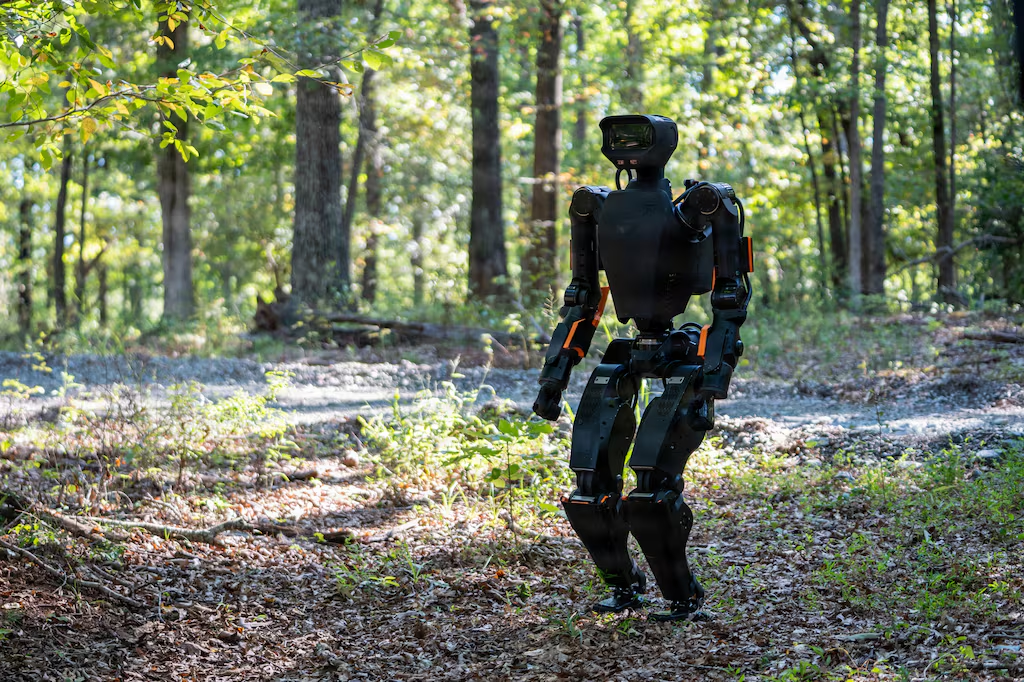
During live testing, participants chose distinct areas of focus. One competitor, IHMC Robotics, concentrated on fundamental physical actions with a bipedal unit named Alex. Observers noted the machine successfully followed verbal instructions to navigate open fields and relied on remote human guidance to traverse difficult terrains like gravel and wooded areas. The machine even demonstrated basic tool use by attempting to shovel dirt before experiencing a system failure that required it to be carried off the field on a stretcher.
Other finalists opted to demonstrate specialized internal components rather than full-body locomotion. Velocity Explorations showcased an advanced software suite designed to monitor personnel radio communications, allowing a robotic unit to interpret human movements and autonomously understand the tactical environment. Meanwhile, Ras Labs displayed sophisticated tactile sensors for robotic fingertips, enabling the safe handling of highly fragile items.
Power generation also took center stage, with Hydroplane Limited and ACES Group presenting novel energy solutions. Hydroplane successfully modified a high-efficiency hydrogen fuel cell, originally intended for larger military structures and drones, into a scaled-down format that could set new baseline power standards for humanoid platforms.
Moving Toward a Practical Future
After the demonstrations, defense officials said the event clarified both the impressive advances in commercial robotics and the major engineering hurdles that still need attention. These insights are expected to strictly guide future military research funding toward innovations that offer the most immediate benefits for active service members.
Despite visual parallels to popular science fiction franchises, industry developers strongly push back against the idea of armed, fully autonomous machines making lethal decisions. Experts cite the current unreliability and vulnerability of artificial intelligence models as a primary reason to keep humans in control. Instead, the primary objective remains focused on occupational safety. Researchers generally agree that the true value of humanoid platforms lies in their potential to replace human personnel in hazardous environments, such as structural fires, obstacle clearing, or radioactive disaster zones.


