
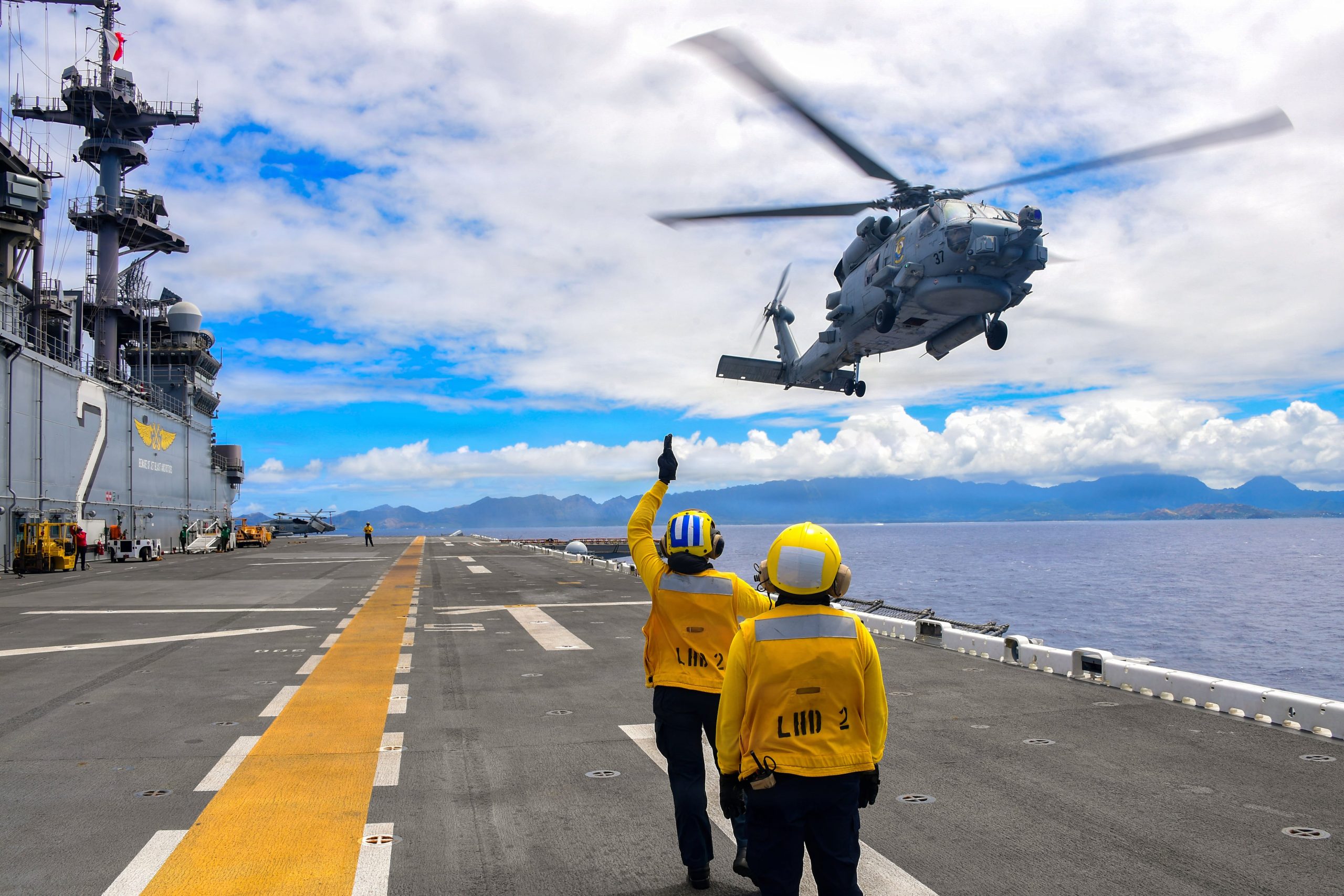
During the multinational Rim of the Pacific military exercises off the coast of Hawaii, the United States Navy conducted field testing on advanced artificial intelligence designed to transform sub-surface tracking operations.
The technology, known as SensorMAX and engineered by defense manufacturer Lockheed Martin, utilizes machine learning algorithms to process underwater acoustic information. Deployed alongside naval air assets, the system aims to modernize anti-submarine warfare by providing real-time data processing and automated target identification in complex maritime environments.
During the multinational drills, naval crew members launched sonar-detecting buoys from MH-60R Sea Hawk helicopters. These sensors captured underwater sound signatures and fed them directly into the SensorMAX framework, allowing the system to assist operators in rapidly isolating and classifying potential sub-surface threats.
Operational Capabilities and Enhanced Surveillance
Traditionally, anti-submarine surveillance relies on human operators manually analyzing acoustic feeds to distinguish between natural oceanic noise, commercial traffic, and military vessels. SensorMAX functions as an automated acoustic analyst, continuously ingesting data from a distributed network of underwater sensors.
By serving as an intelligent processing hub, the system transfers actionable insights between aircrews and ground installations. This integration into existing workflows allows human operators to shift from tedious, raw-data monitoring to high-level decision-making.
By filtering out ambient noise and automatically flagging high-interest signatures, SensorMAX significantly enhances target detection accuracy while reducing personnel cognitive load, ensuring that critical threats are identified faster and with fewer false positives.
One of the primary advantages demonstrated during the testing was a substantial boost in operational capacity. Flight crews utilizing the software were able to monitor eight distinct sonobuoy signals simultaneously. This capability effectively doubles the workload capacity compared to older, legacy equipment, allowing a single aircraft crew to monitor broader stretches of ocean with greater precision.
Rapid Machine Learning and On-the-Fly Updates
A key feature of the software lies in its ability to adapt to unknown or evolving ocean soundscapes without requiring long delays or returning to base. When operators identify an unfamiliar underwater noise signature, ground personnel can manually tag the sound and retrain the artificial intelligence algorithm on the spot. This entire adaptation cycle takes less than 5 minutes to complete.
Once the machine learning model incorporates the fresh data, small update files are securely transmitted over the air via encrypted communication links. Through a partnership with software developer FUSE Incorporated, these updates reach active aircraft without disrupting ongoing flight missions or software operations, ensuring crews maintain continuous situational awareness during critical moments.
Strategic Impact and the Broader AI Competition
By integrating acoustic data across various platforms, the software offers flexibility that extends beyond helicopter operations to ground and surface forces. Rapid classification of sub-surface targets significantly accelerates the anti-submarine operational timeline, commonly referred to as the kill chain. This increased speed enables naval forces to establish a wider protective perimeter around high-value assets, such as aircraft carriers and transport fleets.
The Pacific demonstration highlights a growing global push toward automated undersea warfare. Other major naval powers are actively pursuing similar technological advances. For example, Chinese military researchers have highlighted efforts to merge multi-source data, including sonar signals, water temperature gradients, and salinity levels, into artificial intelligence models to track subsurface vessels, signaling a fast-paced technological competition beneath the surface.


